Social anxiety disorder (also called social phobia) is an intense, persistent fear of being judged, embarrassed or scrutinised by others, strong enough to make you avoid everyday social situations or endure them with great distress. It is more than shyness: it lasts for months, affects work, study and relationships, and often starts in the teenage years. It is very treatable, most effectively with cognitive behavioural therapy (CBT).
What is social anxiety disorder?
Imagine spending four days dreading a five-minute conversation. You rehearse what you might say, how you might look saying it, and every way it could go wrong. By the time it arrives, you are exhausted before it has even started.
This is not shyness. For millions of Australians, this is what social anxiety disorder actually feels like from the inside - and for most of them, it went unnamed for years.
Clinically, social anxiety disorder is diagnosed when fear or anxiety about social situations where you might be scrutinised is out of proportion to the actual threat, leads to avoidance or intense distress, has lasted around six months or more, and gets in the way of daily life. It is one of the most common anxiety conditions in Australia and often begins in adolescence. Many people live with it for years before realising it has a name and can be treated.
How it differs from shyness and everyday nerves

Everyday nervousness is a normal response to high-stakes situations such as interviews, presentations, or public speaking. It usually begins shortly before the event, causes only mild physical symptoms like butterflies in the stomach or slight tension, and fades quickly once the situation is over. With experience, people generally become more comfortable and recover naturally.
Social Anxiety Disorder, on the other hand, can be triggered by even routine social interactions and often begins days or weeks before an event. It is associated with intense symptoms such as a racing heart, blushing, nausea, and overwhelming fear of judgment. The anxiety may continue long after the event through excessive self-analysis, can significantly affect daily life by causing avoidance behaviours, and often worsens without proper treatment.
1. It Attaches to Ordinary Situations
Everyday nerves are situation-specific - speeches, interviews, first days. Social anxiety disorder attaches to routine interactions: ordering coffee, answering the phone, making eye contact on a train. Situations with no objective risk feel intensely threatening.
2. The Anticipation Outlasts the Event
Anticipatory anxiety can begin days or weeks before a social interaction. After the event, the mind replays it in detail - cataloguing every perceived misstep long after everyone else has forgotten it entirely.
3. Avoidance Reorganises the Whole Life
The clearest functional difference is what happens over time. People turn down promotions, stop seeing friends, choose careers based on minimising social exposure. The avoidance grows. The world gets smaller.
Symptoms of social anxiety disorder
Clinical descriptions focus on diagnostic criteria. They do not capture the exhaustion of running a real-time analysis of how you are being perceived through every interaction.
Common physical symptoms of social anxiety disorder
Heart racing or pounding
Blushing or sweating visibly
Shaking voice or trembling hands
Nausea before or during social situations
Chronic fatigue after social engagement
The cycle: The fear of appearing anxious generates the very symptoms that make anxiety visible. This self-reinforcing loop is central to how social anxiety disorder maintains itself over time.
Why So Many People Go Undiagnosed
A common misconception is that people with social anxiety disorder are simply shy. However, while shyness may cause temporary discomfort, it does not significantly interfere with daily functioning. Social anxiety disorder can affect a person's work, relationships, education, and overall quality of life.
Another myth is that social anxiety is the same as introversion. Introversion is a personality trait characterized by a preference for less social stimulation, whereas social anxiety disorder involves intense fear of judgment, embarrassment, or rejection, often leading to avoidance of social situations.
Many people also believe that those with social anxiety simply need to “push through it.” In reality, relying on willpower alone is rarely effective. Without proper support or treatment, avoidance behaviours often become stronger and reinforce the anxiety over time.
There is also a misconception that anyone with social anxiety would have already been diagnosed. In practice, many individuals wait years before seeking help, and a large number of cases remain unidentified or untreated due to stigma, lack of awareness, or difficulty recognizing the condition.
Emotional and behavioural symptoms
Intense fear of being judged, embarrassed or rejected
Worrying for days or weeks before a social event
Avoiding situations such as speaking up in meetings, phone calls, eating in front of others or meeting new people
Relying on "safety behaviours", such as staying near the exit, avoiding eye contact or rehearsing every sentence
Replaying conversations afterwards and focusing on what went wrong
What causes social anxiety disorder?
There is rarely a single cause. It usually develops from a mix of factors:
Temperament and genetics: people who were shy or behaviourally inhibited as children, or who have family members with anxiety, are more likely to develop it.
Life experiences: bullying, teasing, rejection, humiliation or a highly critical environment can teach the brain that social situations are dangerous.
Learned patterns: growing up around anxious or overprotective adults can shape how threatening social situations feel.
Avoidance: each time you avoid a feared situation, anxiety drops in the short term but the fear is reinforced, so the problem tends to grow.
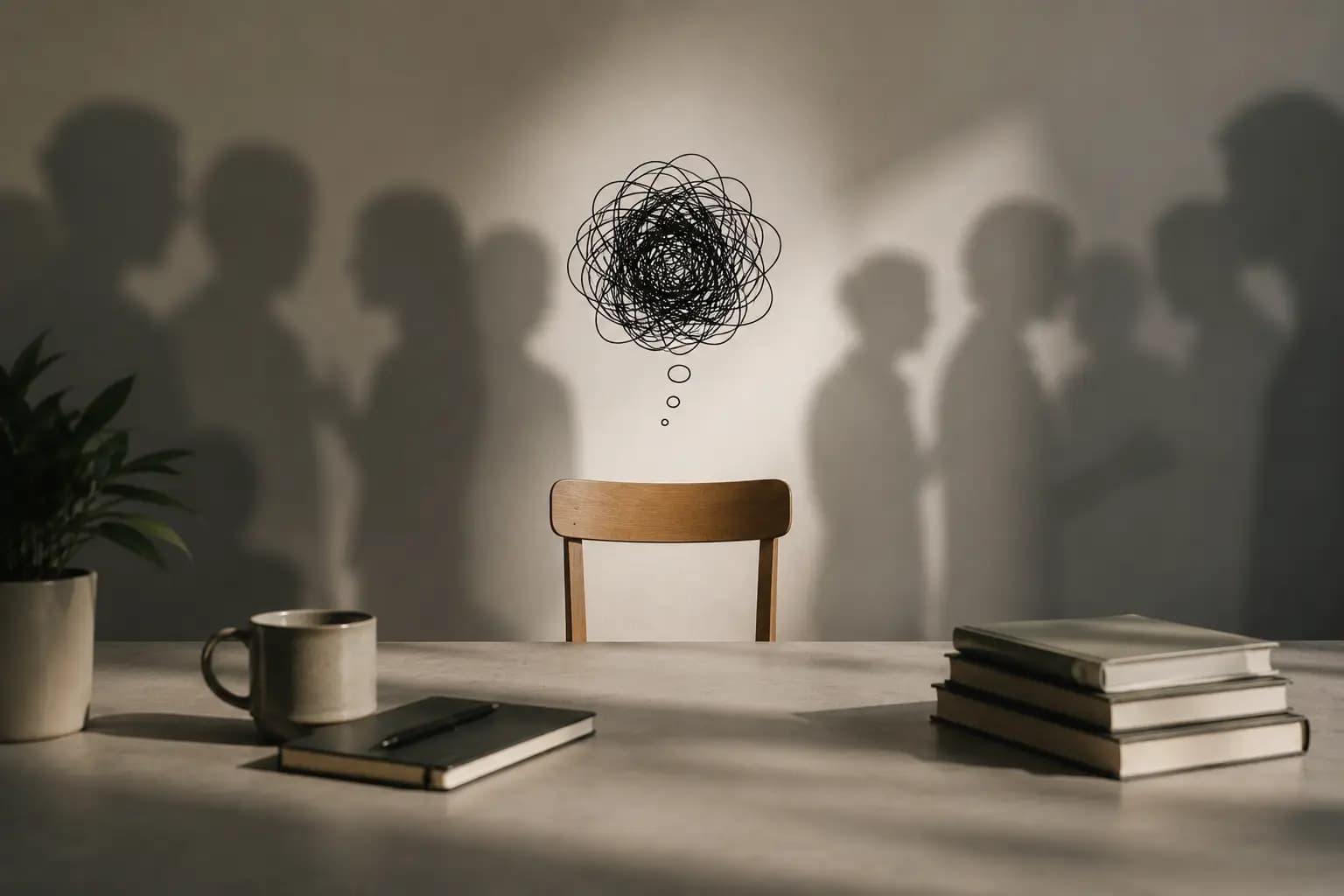
One of the most underemphasised dimensions of social anxiety disorder is what it does to belonging. The condition turns the thing human beings need most - contact with other people - into the primary source of threat.
People with social anxiety disorder often describe a painful duality: wanting connection deeply and fearing the situations that would make it possible. This creates a loneliness that is not simply about being alone. It is about being surrounded by people and remaining unable to reach them.
At KanYini Earth, we understand wellbeing as existing across three dimensions simultaneously: the internal world of thoughts and emotions, the relational world of genuine connection, and the external circumstances of a person's life. Social anxiety disorder creates a profound barrier in the relational dimension, and that barrier feeds back into the internal world. The isolation deepens the anxiety. The anxiety deepens the isolation.
Treatment that works: CBT, exposure and medication
Evidence-Based Treatment Options in Australia
Cognitive Behavioural Therapy (CBT) is considered one of the most effective treatments for social anxiety disorder. It helps individuals identify and change unhelpful thought patterns while reducing avoidance behaviours that maintain anxiety. In Australia, CBT can often be accessed through a GP referral under a Mental Health Treatment Plan, making sessions Medicare-subsidised.
Exposure Therapy involves gradual and structured exposure to feared social situations in a safe and controlled manner. Over time, this helps reduce anxiety and build confidence. It is typically provided by a psychologist or psychiatrist as part of a broader treatment plan.
Medication, particularly Selective Serotonin Reuptake Inhibitors (SSRIs), may be prescribed to reduce baseline anxiety levels and make psychological therapy more effective. These medications are usually prescribed by a GP and are often used alongside CBT rather than as a standalone treatment.
Online and app-based CBT programmes offer a flexible and accessible treatment option for those who may not be ready or able to attend in-person sessions. In Australia, services such as Beyond Blue, This Way Up, and MindSpot provide free or low-cost resources that can help individuals manage social anxiety symptoms.
First step: Healthdirect's social anxiety disorder resources and Beyond Blue's anxiety section are accurate and accessible starting points.
Medication, usually a type of antidepressant called an SSRI, can also help, particularly for moderate to severe social anxiety or when it occurs alongside depression. It is prescribed by a GP or psychiatrist and is often most effective combined with therapy.
Self-help that helps
Learn about anxiety. Understanding the fight-or-flight response makes symptoms less frightening.
Take small steps towards what you avoid. Make a ladder of situations from least to most scary and climb it slowly.
Drop safety behaviours one at a time, and notice that the outcome is usually fine.
Shift attention outward. Focus on the other person and the conversation rather than monitoring yourself.
Use evidence-based online programs, such as free or low-cost digital CBT courses available through Australian services like MindSpot and THIS WAY UP.
Limit alcohol, which can feel like it helps in the moment but worsens anxiety over time.
Where to get help in Australia
Your GP can assess you, discuss treatment and prepare a Mental Health Treatment Plan for Medicare-subsidised psychology sessions.
MindSpot (mindspot.org.au) offers free online assessment and treatment courses for anxiety.
THIS WAY UP (thiswayup.org.au) offers online CBT programs, including for social anxiety.
Beyond Blue: 1300 22 4636 (24/7)
Lifeline: 13 11 14 (24/7 crisis support)
Related reading
Telling Someone Who Is Lonely to 'Love Themselves First' Is Not Advice. It Is a Dismissal.
The Sunday She Decided to Test Whether She Actually Liked Being Alone
Connection is what makes the difference
KanYini Earth is building accessible wellbeing resources for the millions of Australians who navigate social anxiety in isolation. If this resonated, consider being part of what we are building.
There are many ways to be part of this. You can donate once or set up a monthly gift, sponsor a resource, volunteer your expertise, or follow and share to reach someone who needs it. Every contribution moves the same mission forward.
Support is available: Beyond Blue 1300 22 4636 | Lifeline 13 11 14
References
Australian Bureau of Statistics. (2022). National Study of Mental Health and Wellbeing. https://www.abs.gov.au/statistics/health/mental-health
Black Dog Institute. Anxiety resources. https://www.blackdoginstitute.org.au/resources-support/anxiety/
Healthdirect Australia. Social anxiety disorder. https://www.healthdirect.gov.au/social-anxiety-disorder
Beyond Blue. Social anxiety disorder. https://www.beyondblue.org.au/mental-health/anxiety/types-of-anxiety/social-anxiety-disorder