Belonging was built into daily life, not added on top
The difference between then and now is not that older cultures valued connection more highly as an idea. It is that their connection was structural. It did not depend on anyone feeling motivated to reach out. It was woven into the ordinary mechanics of living.
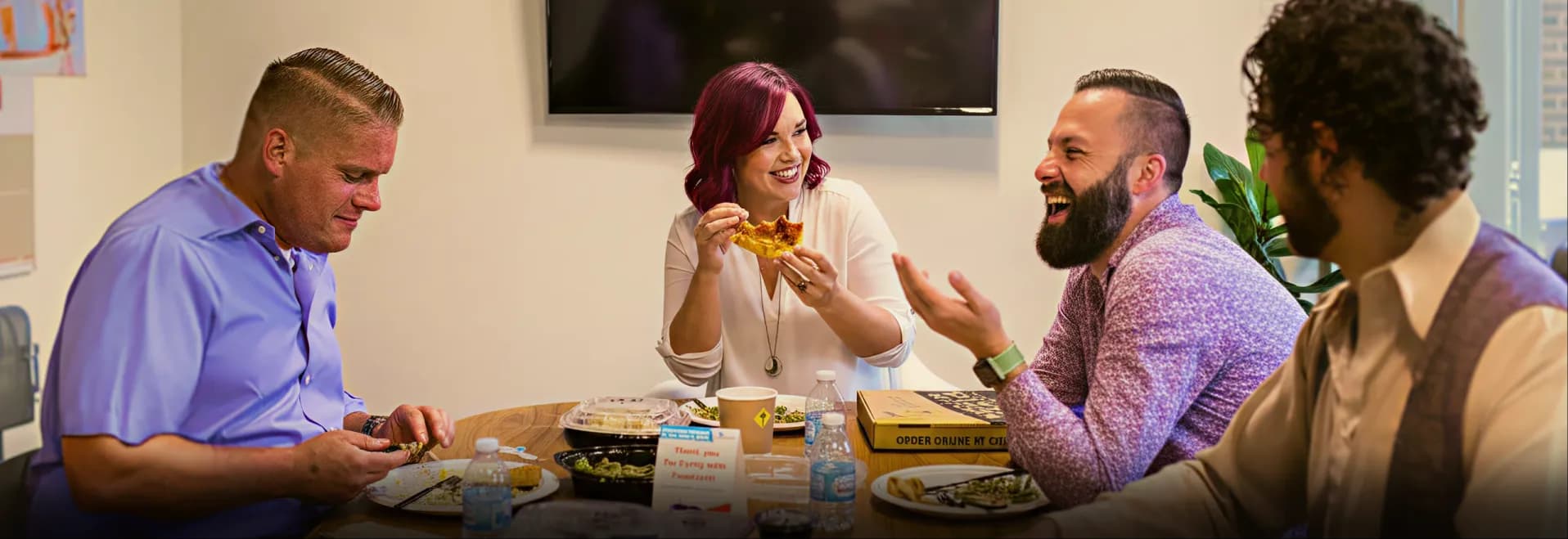
Meals were shared, prepared and eaten together as a matter of course rather than grabbed alone between tasks. Children were raised by more than their parents, held by a wider circle of relatives and neighbours who all had a stake in them. Elders were kept close and treated as carriers of knowledge rather than moved to the edges of life. Work was often communal, done alongside others toward a shared end. And the rhythms of the year were marked by ritual and gathering, regular occasions that pulled the whole community into the same place for the same purpose. None of this required a person to be socially skilled or particularly outgoing. Belonging arrived automatically, as a feature of how life was arranged.
Anthropologists who study small and cohesive societies describe exactly this: belonging embedded in shared institutions, in ritual, in shared labour, in the everyday obligations people held to one another, all of which sustained personal ties and offered real protection against isolation. The connection was not a personal achievement. It was a property of the community itself.
What we traded, and what it cost
Almost every step that dismantled this was reasonable on its own terms. Mobility let people leave for opportunity, and they did, moving away from the web that held them. Privacy and independence became prized, and the shared wall between households became a fence. Convenience let us do alone what once required others, until the small daily needs that used to bring people into contact quietly disappeared. Screens gave us the appearance of contact without its substance.
Each of these was a genuine gain. Together, they hollowed out the structures that used to make belonging automatic, and left in their place a world where connection has become a personal project, something each individual now has to seek out, build, and maintain through sheer effort, in whatever time is left over. It is exhausting in a way that belonging was never meant to be, and the loneliness statistics are, in large part, the measure of that exhaustion.
The science is catching up to the old knowledge
What modern research now confirms, at considerable expense and after decades of study, is very close to what those older ways of living already assumed. That social connection is among the strongest predictors of long-term health and happiness there is. That isolation carries measurable physical risk, comparable to well-known dangers we take far more seriously. That belonging to a community, being part of something larger than yourself, buffers stress and protects wellbeing in ways that individual effort cannot replicate.
None of this would have surprised our ancestors. They did not have the studies, but they had the arrangement, and the arrangement worked. What we are calling discovery is in many ways a recovery, a slow scientific confirmation of something older cultures understood well enough to build their entire way of life around.
Relearning it on purpose
We are not going to return to the way things were, and we would not want all of it back. The point is not nostalgia. The point is that belonging does not have to be left to chance and individual effort. It can be rebuilt deliberately, in forms that fit the lives we actually live.
This is the understanding at the centre of KanYini Earth, and it is one that Aboriginal and Torres Strait Islander cultures, among the oldest continuous cultures on earth, have carried for tens of thousands of years. KanYini, in the Pitjantjatjara language, names the principle of connectedness through caring and responsibility: the understanding that we are bound to one another, to the land, and to something larger than ourselves, and that this belonging carries obligation in every direction. It is not a relic. It is a design for living that the modern world, having wandered a long way from it, is now slowly finding its way back toward.
The old cultures were right about belonging. The work now is to build it again, on purpose, in the time and the world we have.
If this resonated with you
KanYini Earth is a not-for-profit rebuilding the structures of belonging that modern life has worn away, through community, connection, and accessible wellbeing courses grounded in the principle of connectedness. If that is a movement you would like to be part of
Walk with KanYini Earth.