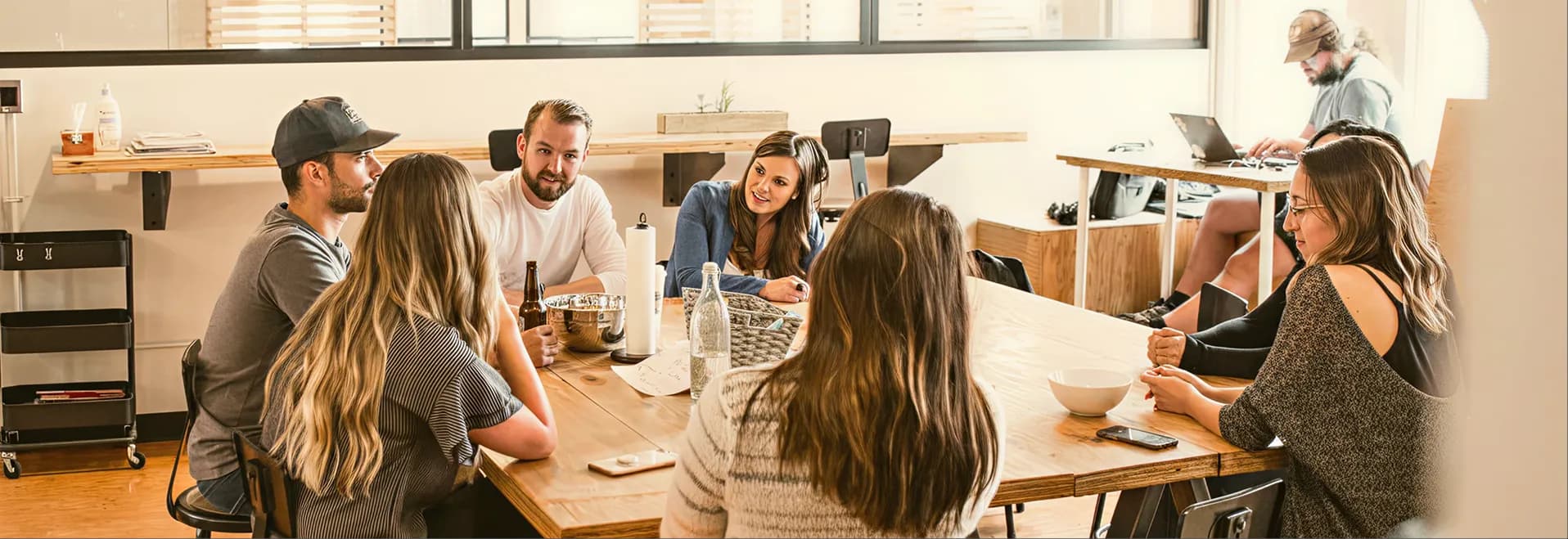
The Person at the Next Desk
Tom has worked on the same floor as Sarah for almost three years. They say hello most mornings. They have eaten lunch in the same kitchen hundreds of times. He knows she has a dog. She knows he follows cricket.
They are perfectly friendly.
And they know almost nothing about each other.
If you asked Tom whether he has positive working relationships, he would probably say yes. No conflict. No drama. Everyone gets along fine.
But getting along fine and feeling genuinely connected are two very different things. One is the absence of friction. The other is the presence of trust. And the gap between those two things shapes more of your working life than most people realise. The same principles that build a strong working relationship are at work when we look at why social harmony starts with relationships at the community level.
The Quiet Cost of Keeping Things Surface-Level
There is a particular kind of loneliness that lives inside busy, populated workplaces. It is not dramatic. Nobody is sitting in a corner crying. It looks like people chatting in hallways and eating together and joining meetings on time.
But underneath the pleasantries, a lot of people feel unseen.
A 2025 KPMG survey of working professionals found that 45% of employees now report feeling lonely at their workplace. That figure nearly doubled in a single year. Not because offices got emptier. Because surface-level connection, the kind most workplaces run on, was never enough to begin with.
What makes this matter is that it does not just affect how people feel. It affects how they work. The same research found that the majority of professionals say workplace friendships directly improve their engagement, satisfaction, and even their productivity. When people feel genuinely connected to their colleagues, they stay longer, try harder, and handle pressure better.
The reverse is also true. When people feel isolated, even in a room full of colleagues, their motivation drops. Their willingness to go above and beyond fades. They start watching the clock. These are often early indicators of workplace disengagement that leaders overlook
This is not about being an extrovert or joining the social committee. It is about something much simpler and much harder: feeling like the people around you actually see you.
Why We Stay on the Surface
If deeper connection at work is so clearly a good thing, why do most of us avoid it?
Because it feels risky.
Small talk is safe. Nobody gets hurt asking about the weekend. Nobody is vulnerable talking about the weather. We have all learned, implicitly, that workplaces reward a certain kind of performance: competent, composed, emotionally contained.
Going deeper means risking something. It means asking a question you do not already know the answer to. It means admitting you are struggling when the culture says you should be coping. It means noticing that someone else is struggling and choosing to say something, even if it might be awkward.
Most people do not stay shallow out of laziness. They stay shallow out of self-protection. And in workplaces where vulnerability has historically been punished, or at least not rewarded, that instinct makes perfect sense.
The problem is that self-protection, at scale, creates cultures where everyone is pleasant but nobody feels known. And over time, that quiet disconnection erodes something essential.
What Deeper Actually Looks Like (It Is Smaller Than You Think)
Here is the good news. Building positive working relationships that go beyond small talk does not require grand gestures, team retreats, or personality quizzes. It requires attention.
The University of Kansas found that it takes roughly 50 hours of shared time to move from acquaintance to casual friend. In a workplace, that time is already being spent. The question is not whether you have enough hours. It is whether anything real happens inside them.
Remember something
One of the simplest things you can do is remember a detail someone shared and ask about it later. Sarah mentioned her dog was at the vet last week. Next Tuesday, Tom asks: "How is the dog going?"
That is it. Four seconds. But it says: I was listening. You are not invisible to me.
Most people underestimate how powerful this is. In a world of rushed meetings and back-to-back deadlines, being remembered feels like a small miracle.
Ask one real question
Not "How was your weekend?" which almost always produces "Yeah, good, you?"
Try: "What is something you did this weekend that you actually enjoyed?"
Or: "What is something you are working on right now that you find interesting?"
The difference is specificity. A specific question invites a real answer. And a real answer creates the possibility of an actual conversation.
Be the one who notices
When someone seems flat, distracted, or off, most people look away. Not out of cruelty. Out of uncertainty. They do not want to intrude.
But the people who build the strongest relationships at work are the ones who say, simply: "Hey. You seem a bit quiet today. Everything alright?"
You do not need to solve anything. You do not need to be a counsellor. You just need to notice. That alone changes the dynamic. In stronger cultures, this awareness is supported by practices like mental health safety planning.
Share something first
Vulnerability is not a one-way street. If you want others to be real with you, you have to go first sometimes.
That does not mean oversharing in the Monday standup. It means saying, when it is true: "Honestly, I found that project pretty stressful." Or: "I am still figuring out how to manage this new workload."
When one person drops the mask, it gives everyone else permission to do the same.
Why This Matters Beyond Your Desk
We spend an estimated 80,000 hours at work over a lifetime. That is more time than we spend with our partners, our friends, or our families during waking hours.
If all of those hours are spent in polite, pleasant, but ultimately hollow interactions, something gets lost. Not just productivity or engagement. Something more personal.
Because the quality of our relationships at work shapes the quality of our days. And the quality of our days, stacked up, shapes the quality of our lives.
There is a version of work where you show up, do your job, nod at the right people, and go home. It is functional. Millions of people live in it.
And there is a version where the people around you know something real about you. Where someone notices when you are having a rough week. Where you feel, even in a small way, that you belong.
The difference between those two versions is not luck. It is not personality. It is a series of choices, most of them tiny, made again and again over time. And increasingly, these behaviours are being assessed as part of broader workplace health and safety audits.
One Last Thing
At KanYini Earth, an Australian not-for-profit organisation rooted in an ancient philosophy of connection, we spend a lot of time thinking about the spaces where disconnection hides. Not just in crisis, but in the ordinary. In the kitchen at work. In the hallway you walk down twice a day. In the meetings that could be emails.
Our work spans writing, storytelling, education, and public conversation. All of it is guided by a simple belief: that when people feel genuinely connected to the people around them, everything else works better. Not just at work. Everywhere.
The learning programs we are building are designed for exactly this kind of shift. Helping people recognise when someone around them is struggling. Giving people the confidence to step in, even when it feels awkward. Because the gap between surface-level and genuinely connected is not as wide as it seems. Often, it is one honest question.
If that matters to you, there are a few ways to be part of what we are building. You can explore our resources. You can join the conversation. And if you want to help this kind of work reach more people, you can contribute at KanYini Earth. Every contribution helps us develop programs, create content, and bring this philosophy to more workplaces and communities across Australia.
Because the person at the next desk? They are probably waiting for someone to go first.
KanYini Earth. Walk with us
References
KPMG. (2025). Workplace loneliness and connection survey. KPMG. (Confirm exact title and URL — the blog references a 2025 KPMG survey finding 45% of employees feel lonely at work.)
Hall, J. A. (2018). How many hours does it take to make a friend? Journal of Social and Personal Relationships, 36(4), 1278-1296. https://doi.org/10.1177/0265407518761225